- INGLES OCTAVO -
PLAZO: NOVIEMBRE 13 o Antes mejor
Recomendaciones:
1. Estudiar el contenido y resumir en el cuaderno junto con ejercicios de complementación del tema.
2. Desarrollar cada taller del contenido del blog en el cuaderno.
Tema: Comparatives/superlatives.
Competencia: Compara rasgos entre sujetos formando textos contextualizados.
___________________________________________________________________
Adjectives:
Los adjetivos son palabras que designan características de un sujeto.
Beautiful= Bonito Ugly=Feo Fast= Rapido Nice=Bueno Good=Bueno Big= Grande
Los adjetivos en ingles sufren ciertos cambios al ser usados en diferentes situaciones en contexto:
Los comparativos y superlativos se forman a partir de la forma de los adjetivos, es decir acorde a las silabas y como terminan, pero también hay unos pocos adjetivos irregulares que tienen sus propias formas como GOOD:


0. The helichopter is (cheap) __cheaper than__ the airplane.
A.The truck is (slow) _______________ the helicopter.
B.The airplane is (fast) ______________ the ship.
C.The airplane is (heavy) _________________________ the helicopter.
D.The helichopter is (Light) _______________ the truck.
E.The ship is (Expensive) _________________ the truck.
Exercise 3:
Write the superlative to complete the sentences and translate to Spanish:
0. The Helichopter is (light) __the lightest of the group.
A.The truck is (slow) ____________________ of the group.
B.The airplane is (fast) ___________________ of the means of transportations.
C.The ship is (heavy) _________________________ of the group.
D.The helichopter is (beautiful) ____________________ of the means of transportations.
E.The airplane is (Expensive) _________________ of the group.
Exercise 4:
Copy the text and translate to Spanish.
TRANSPORTATION NOWADAYS

Today the motorcycle and the car are means of transportation more common than the bicycle, making comparisons, the car is faster than the motorcycle, but the motorcycle is smaller than the car and it is easier to drive than the car in many roads especially on traffic jam. The car is more expensive than the motorcycle although the motorcycle is more dangerous than the cars about accidents.
The motorcycle use less gasoline than the car, for this reason to have a motorcycle is cheaper than the car. Other characteristic about the car is that the car is heavier than the motorcycle and the car is longer than the motorcycle. Concluding, It´s better to have a bicycle because it is cleaner with the environment according to ecological targets.
Exercise 5:
Write 2 comparative sentences, 2 superlative sentences about the next geometric figures

TALLER:
NO ENVIAR NADA, el desarrollo del taller se evidenciará en el examen. Este es el examen.
I. Traduce y responde el siguiente Test tipo ICFES.
1) The blue car is ______ than the red car.
A. more fast B. more faster C. faster D. fast
2) Angel Falls is 979m high and is located in Venezuela, It is the _____ falls in the world
A. most high B. highest C. fastest D. more high
3) The hottest temperature recorded on the Earth is 58°C in African continent, the country is: A. Libya B. Nicaragua C. Spain D. Russia
4) There is a place in the world, Puerto Lopez, Colombia, where ______ almost every day, It falls 13,3m water a year, it is the wettest place in world: A. rain B. fire C. cold D. earthquake
5) In Commonwealth Bay winds blow at 240Km/h, it is the ________ place in the world.
A. Wind B. Cold C. Windy D. windiest
Read and translate to Spanish, then answer questions 6 to 10:
The pet store
George is at the pet store, looking for a kind of pet he might want to get for his birthday. George asked if he could have a horse, but his parents said no because horses are bigger than dogs, horses are the biggest animal in the store. First, he sees dogs and cats. Baby dogs are called puppies. Baby cats are called kittens. George likes them because they are easy to take care of and can play a lot, but they will get bigger. George wants a smaller pet.
Then George sees animals that can live in a cage. He sees rabbits and guinea pigs, but he wants a smaller animal, then he sees mice. Mice are the plural to what you call more than one mouse. He likes these animals because they are the most affectionate. Birds live in cages too but they are noisier than mice. George sees a parrot and a canary. He likes them all, but he doesn’t want to clean the cage, sometimes he thinks birds are dirtier than mice.
George sees the animals in tanks. The tanks full of water have fish and turtles in them. He thinks about a goldfish but decides he likes the turtles more. There are also tanks with rocks and sand that have snakes, spiders, and scorpions, but George is afraid of them. George likes the turtles best, but they won’t fit in the little fishbowls. Turtles need bigger tanks, so they can swim sometimes and hide sometimes.
George decides he wants to get a turtle for his birthday. He buys a book on how to take care of a turtle and a list of what types of turtles the store sells.
6) What kind of pet did George want, but his parents said no because they were too big?
A.A Horse B. A Puppy C.A Kitten D.A Rabbit
7) What kind of pet does NOT live in a cage?
A. Mouse/Mice B. Guinea pigs C. Goldfish D. Rabbits
8) Which kind of pet did NOT scare George?
A. The Scorpions B. the Snakes C. the Canaries. D. The Spiders
9) What kind of pet did George decide he wanted to get for his birthday?
A. Turtle B. Goldfish C. Mouse D. Parrot
10) Sometimes George thinks that birds are _____ than mice
A. harder B. dirtier C. cleaner D. bigger
II. Acorde al desempeño personal de todo el taller la nota de mi auto-evaluación es: 3,5 4,0 4,5 5,0
III. Presenta la evaluación. Debes
iniciar primero sesión en GOOGLE y luego dar click al enlace para acceder a la
evaluación. NO aparecerá ni una palabra en el examen, debes poner solo la letra
que seleccionaste en cada número. EJ.
1.A 2.C 3.A…
etc. Debe tener correo en GOOGLE para
presentar las evaluaciones (Ejemplo: pepito20@gmail.com).
Evaluación Comparatives Superlatives:
https://forms.gle/NeYhH7NrdcER6wdv9
PLAZO: Septiembre 24 o Antes mejor
Recomendaciones:
1. Estudiar el contenido y resumir en el cuaderno junto con ejercicios de complementación del tema.
2. Desarrollar cada taller del contenido del blog en el cuaderno.
Tema: Possessives, giving direction.
Competencia: Cuestiona y argumenta situaciones personales y de su entorno a través de explicaciones sencillas, razonables y coherentes, a la vez que da direcciones y ubicaciones.
___________________________________________________________________
Possessive adjectives: sirven para relacionar la pertenencia de algo a alguien.
Mira el cuadro de los posesivos, luego completa la lectura del mensaje de Ben y traducelo a español escribiendo los posesivos con rojo.


Clausula relative “THAT” (…que…)
Use the relative clause ‘that’ to define words related to animal behavior.
Example:
(Acuaticos)= Animales acuaticos son aquellos que viven en el agua.
(Aquatic)= Aquatic animals are animals that live in water.
(Terrestrial)=
(Aerial)=
(Wild)=
(Domestic)=
Giving directions. (lugares de la ciudad y preposiciones de lugar)
Observa con atencion el mapa, luego traduce las conversaciones y oraciones de los siguientes ejercicios y completa con las opciones correctas segun el caso.

1. Hi. I have a bad cough. Could you please tell me where the __________
is?
Sorry to hear about that. You will find the _________ on the northwest
corner of Border Avenue and Front Street.
a) City Park b) City Clinic C)Bakery d)Grocery Store
2. Excuse me, I am looking for the __________.
Do you know where I could find it?
Yes. The ________ is on Short Avenue, across the street from the
library.
a) Bank b) Fire Station C)Bakery d)Grocery Store
3. Can you help me? I am looking for the __________. Do you know where it is?
Sure, it's located across from the grocery store next to the Elementary School.
a) Video Store b) City Park C) Bakery d) City Middle School
TALLER:
NO ENVIAR NADA, el desarrollo del taller se evidenciará en el examen. Este es el examen.
I-Traduce y responde el siguiente test tipo ICFES.


5). Martha forgot that she needs to save some money, and she returned to the __________ next to the supermarket.
a. Bank b. city clinic c. Gas station d. Bakery
II. Acorde al desempeño personal de todo el taller la nota de mi auto-evaluación es:
3,5 4,0 4,5 5,0
III. Presenta la evaluación. Debes iniciar primero sesión en GOOGLE y luego dar click al enlace para acceder a la evaluación.
OJO: NO aparecerá ni una palabra en el examen, debes poner solo la letra que seleccionaste en cada número. EJ. 1.A 2.C 3.A… etc. Debe tener correo en GOOGLE para presentar las evaluaciones (Ejemplo: pepito20@gmail.com). Evaluación Going Shopping: https://forms.gle/hdoSE584ykL8JsaF7
PLAZO: JULIO 21 o Antes mejor
Recomendaciones:
1. Estudiar el contenido y resumir en el cuaderno junto con ejercicios de complementación del tema.
2. Desarrollar cada taller del contenido del blog en el cuaderno.
Tema:
Frequency adverbs.
Competencia: Expresa
la continuidad con que desarrolla actividades cotidianas usando adverbios de
frecuencia en inglés.
___________________________________________________________________
Los adverbios de frecuencia se usan para expresar la continuidad o frecuencia con que se realiza cierta actividad cotidiana durante la semana o en una jornada común y corriente, comúnmente representada con porcentaje siendo 100% siempre y 0% Nunca. Estos adverbios se usan antes del verbo en inglés.
FREQUENCY ADVERBS
|
100% |
Always |
Siempre |
|
90% |
Usually |
Usualmente |
|
80% |
Frequently |
Frecuentemente |
|
70% |
Often |
A manudo |
|
50% |
Sometimes |
A veces |
|
30% |
Occasionally |
Ocasionalmente |
|
10% |
Seldom |
Casi nunca |
|
5% |
Rarely |
Raramente |
|
0% |
Never |
Nunca |
Ej. How often Luis take a shower? (90%) ¿Con que frecuencia Luis toma un baño?
Luis Usually takes a shower. Luis usualmente toma un baño
How often you go to mass? (5%) ¿Con que frecuencia usted va a misa?
I rarely go to mass. Yo raramente voy a misa.
Ejercicio Práctico.
A) Completa y traduce las oraciones.
1. Our teacher, Mrs Jones ___________________ arrives late for lessons. (5%)
2. I ____________ clean my bedroom at the weekend. (70%)
3. My brother __________________ helps me with my homework. (30%)
4. I ____________ bored in the maths lessons. (50%)
5. We ___________ watch football on TV. (10%)
6. You and Tony _______________ play computer games with me. (90%)
7. You _____________ visit the sports center on Sunday. (0%)
8. The school bus ________________ arrive at half past eight. (80%)
TALLER:
NO ENVIAR NADA, el desarrollo del taller se evidenciará en el examen. OJO:Este es el examen.
A) Complete the sentences with the correct frequency adverb.
1. Mr.Goodson ___________ gets up at 6:30. (80%) A.Often B.Never C. Frequently
2. She _____________ plays the flute. (30%) A. Rarely B. Occasionally C. Frequently
3. I ____________ walk my dog in the park. (70%) A.Often B.Never C. Frequently
4. He __________ reads an English story book. (10%) A. Rarely B. Occasionally C. Seldom
B) Organize correctly the
sentences: Organiza correctamente las oraciones:
5. never / food / Julia / eats / fast
A. Julia eats never fast food B. Julia never eats fast food. C. Julia eats food fast never.
6. play / they / sometimes / volleyball
A. They play volleyball B. They play volleyball sometimes. C. They sometimes play volleyball
7. cat / milk / drinks / always/ the
A. The cat always drinks milk. B. The cat always drinks milk. C. Julia eats food fast never.
C) Select the correct answer
to the next questions: Selecciona la respuesta correcta a la pregunta.
8. How often do you have breakfast in the morning? (90%)
A. I usually have breakfast in the morning
B. I seldom have breakfast in the morning
C. I often have breakfast in the morning
9. How often does Sam send e-mails to his friend? (50%)
A. Sam sometimes sends e-mails to his friend
B. Sam frequently sends e-mails to his friend
C. Sam rarely sends e-mails to his friend
10. How often do they cook pizza? (70%).
A. They often cook pizza
B. They never cook pizza
C. They always cook pizza
B)
Presenta la evaluación del tema siguiendo el enlace. Debes iniciar primero
sesión en GOOGLE y luego dar click al enlace para acceder a la evaluación. NO
aparecerá ni una palabra en el examen, debes poner solo la letra que
seleccionaste en cada número del ejericicio anterior. EJ.
1.A 2.C 3.A…
etc.
Debe tener una cuenta o correo en GOOGLE para
presentar las evaluaciones (Ejemplo: pepito20@gmail.com)..
Evaluación Frequency adverbs.
https://forms.gle/ftZ81zncQ96nugdr6
PLAZO: JUNIO 16 o Antes mejor
No tienes internet? DESCARGA CONTENIDO PDF
https://drive.google.com/file/d/1j77bBhF8W2Ik4gPhbtLREvFUSMtbD9kW/view?usp=sharing
Recomendaciones:
1. Estudiar el contenido y resumir en el cuaderno junto con ejercicios de complementación del tema.
2. Desarrollar cada taller del contenido del blog en el cuaderno.
Tema:
Testing ICFES Proof.
Competencia: Desarrolla
habilidades de competencia para desarrollo de pruebas SABER.
___________________________________________________________________
Teniendo en cuenta el conocimiento y habilidades adquiridas en cuanto a contenidos y competencias comunicativas en el idioma inglés, desarrolla el siguiente material preparativo tipo ICFES-SABER.
Ejercicio Práctico.
Lee interpretando comprensivamente los ejercicios, traduce y responde.
1) Relaciona con colores las oraciones con la palabra del vocabulario de la derecha.


TALLER:
NO ENVIAR NADA, el desarrollo del taller se evidenciará en el examen.
A) Lee interpretando comprensivamente los ejercicios, traduce y responde. Esta es la evaluación.

B)
Presenta la evaluación del tema siguiendo el enlace. Debes iniciar primero
sesión en GOOGLE y luego dar click al enlace para acceder a la evaluación.
Debe tener una cuenta o correo en GOOGLE para
presentar las evaluaciones (Ejemplo: pepito20@gmail.com).
Evaluación ICFES proof.
https://forms.gle/SSFXrHmRwo3Kg7Gh9
¿No tienes internet? DESCARGA EL MATERIAL EN PDF:
Tema: Simple Past and linking words
Competencia: Cuestiona y argumenta situaciones personales y de su entorno a través de explicaciones sencillas, razonables y coherentes.
___________________________________________________________________
Primero hay que saber que hay dos clases de verbos. Regular e Irregulares, los irregulares se encuentran comúnmente en un listado con sus formas de pasado en frente, y los verbos regulares obtienen su forma de pasado con la terminación en _ED. pero siguiendo ciertas reglas.
VIDEO Explicativo.
VERBS
REGULAR Verbs IRREGULAR Verbs
*terminan en ED *tienen listado *No siguen reglas *Hay que memorizarlos
Regular verbs Rules Example
R1: verbo termina en _e agrega d Dance - danced
R2: Verbo termina en _s,sh, ch, x, z agrega _ed Watch -Watched
R3: Verbo termina en _letra + Y remplaza Y por _ied Copy - copied
Si verbo no cumple ninguna regla agrega _ed Talk - talked
Auxiliar del tiempo pasado simple:
El verbo Do en pasado (DID) funciona como auxiliar en oraciones negativas e interrogativas, importante recordar que si va el auxiliar en una oración, el verbo principal de la oracion debe ir normal.
OJO: oraciones con ser o estar (BE) siempre se usa este mismo verbo.
Pronouns Do BE
I Did was
YOU Did were
He - She - It Did was
We Did were
They Did were
Lucy trabajó duro ayer. Yo estaba en el parque ayer.
Affirmative Lucy worked hard yesterday. I was in the park yesterday.
Negative. Lucy did not work hard yesterday I was not in the park yesterday
Interrogative. Did Lucy work hard yesterday? Was I in the park yesterday?
OJO: para saber cómo clasificar un verbo, PRIMERO debemos buscarlo en el listado de irregulares, si aparece, es irregular por tanto tiene su forma de pasado en frente, si no aparece, suponemos que es regular y aplicamos regla correspondiente.
Tipos de Oraciones
Affirmativas: Deben llevar el verbo en pasado, y pueden ir complementadas con expresiones de tiempo.
Negativas: Se usa la particula carcteristica de negacion "NOT" despues del auxiliar del pasado.
Interrogativas:
Se inician con una clausula WH- si requiere información como respuesta
o primero el auxiliar para respuestas simples: si, no.
Practice exercises:
1. Write the meaning and the past of next verbs, Circle color red the irregular verbs and color blue the regular verbs.
Paint Go Think
Buy Drink Study Mix
Shout Give Arrive
2. Complete the next sentences in past and translate to Spanish.
a. My father (buy) _____________ a new TV yesterday in the market.
b. The Mayor (shout)______________ to the people “I promise that”.
c. The study (show)_________ that lot of people (eat) ________ junk food for dinner.
3. Complete, write the sentences in Affirmative, negative or interrogative.
Example. Aff. The red Bull (run)_ran_ fast in the meadow.
Neg. The red bull did not run fast in the meadow
Int. Did the red bull run fast in the meadow?
+Yes, It did.
- No, It did not.
a. Aff.
Neg. The lions did not hunt the zebra yesterday.
Int.
+
-
b. Aff.
Neg.
Int. Did she come to my house last night?
+
-
MY VACATIONS
On my last vacation my family and I went to California. Every day in the morning we ate corn flakes and my father ate bacon with eggs and drank orange juice. My sister washed the dishes, my grandmother swept the floor and cleaned the bedrooms, and I swam in the pool. In the afternoon we rode bikes and walked in the beach. At night I watched tv. And my brother jumped the rope and played soccer. My mother and my father read magazines.
Example. Where did I go vacations? On my last vacation my family and I went to California.
a. What did we usually eat for breakfast? _________________________
b. What did we usually do in the afternoon? ______________________
c. What did usually do my parents at night? ______________________
A) Poner la forma pasado del verbo, luego relaciona las oraciones de inglés con sus oraciones correspondientes en español colocando la numero en frente.
1. An engineer from Bogotá (offer) ________ him a computer.
2. The Judge (arrive) __________ tired, slow, and full, from the lunch,
3. He was happy because he (give) _______ the job to the boss.
4. Mario (look) _________ at all the work in his office to be finish.
___ Él estaba feliz porque entregó el trabajo al jefe.
___ Mario miró todo el trabajo en su oficina por hacer.
___ Un ingeniero de Bogotá le ofreció un computador.
___ El Juez llegó cansado, lento, y lleno, del almuerzo,
B) Completa la historieta ubicando el numero de cada oración en inglés debajo de cada imagen correspondiente:

Evaluacion Pasado simple
¿No tienes internet? DESCARGA EL MATERIAL EN PDF:
https://drive.google.com/file/d/1zsPiS3FgSW6KyS9MFwEXjOIuLzzOeyLM/view?usp=sharing
OBSERVACIONES DE TRABAJO ACADÉMICO.

Escribir nombre grado y codigo en el mensaje.
Recomendación:
Tema: Illness and feelings
Competencia: Interpreta situaciones y problemas de salud a partir de gestos o representaciones graficas y brinda algunas sugerencias que ayuden a mejorar la situación..
___________________________________________________________________
Feelings and moods.
Deduce el significado las palabras de vocabulario sobre sentimientos acorde a los emoticones.

Illness and health vocabulary
Busca las palabras de vocabulario de salud en la sopa de letras y escribe su significado al frente.

Giving suggestions.
A diario se presentan situaciones donde es importante tener empatía para comprender a los demás y darles una mano o un consejo al menos. esto se hace siguiendo el siguiente ejemplo.
Se pregunta cual es problema, luego como se siente la persona y luego se dá una sugerencia usando algún verbo modal acorde a la obligación que amerite el caso. Se usa vocabulario de feelings y de problemas de salud. La recomendación se hace a modo personal y coherente acorde al caso.
Esta es la estructura de los ejercicios:
*what is the trouble?
> ______ feel _______ because ________
*____ should __________________.

*What is the trouble?
> I feel sad because I have a bruise on my leg.
*You should apply a special cream.

*What is the problem?
> Homer feels frightened because he has a rash.
*He should go to the doctor.

*What is the trouble?
> Sandra feels hysterical because she has a headache.
*She should take a pill.
Taller: Giving suggestions.
A) Busca 5 imagenes o dibuja los casos. y desarrolla el ejercicio usando el vocabulario visto en los emoticones y la sopa de letras. sigue los ejemplos. (Hoja de block toma foto envia por wassap)
B) Presenta el examen siguiendo el enlace.
Debe tener una cuenta o correo en GOOGLE para presentar las evaluaciones (Ejemplo: pepito20@gmail.com).
Evaluacion Feelings and illness. - Giving suggestions.
https://forms.gle/zVi6DVaAEsTygfvX6
Tema: El Gerundio - ING
MAYO 4 a 14 - SEGUNDO PERIODO
Competencia: Comprende el uso del gerundi en tiempo presente continuo para comunicar hechos de la vida cotidiana en inglés.
___________________________________________________________________
1. Si el verbo acaba en -e, hay que reemplazarla por -ing. Excepto: See → Seeing be→ being
Ej. eat → eating ask → asking go → going
Para compementar mira el video:
Uso y reglas del ing con ejemplos.
https://www.youtube.com/watch?v=PeubuXzxS-0
Practice exercise.
A) Completa las siguiente oraciones agregando el gerundio (-ing) a los verbos en parentesis, luego traduce las oraciones.
(tomado de: https://www.superprof.es.)
Present continuous or present progressive
Se usa para expresar hechos del presente que se estan llevando a cabo.
Se llama presente continuo porque debe ir:
Presente continuo
verbo "To Be Verbo de la
conjugado oracion en -ing
en presente
Ej. Camilo is playing in the park
Camilo está jugando en el parque.
Ej: Los estudiantes están corriendo a lo largo de la playa.
the students are running along the beach.
Recordamos que el verbo "Be" significa ser/estar y se conjuga de acuerdo a las personas o pronombres de la siguiente forma en presente:
Pronouns Be
Forma de oraciones en presente continuo o progresivo:
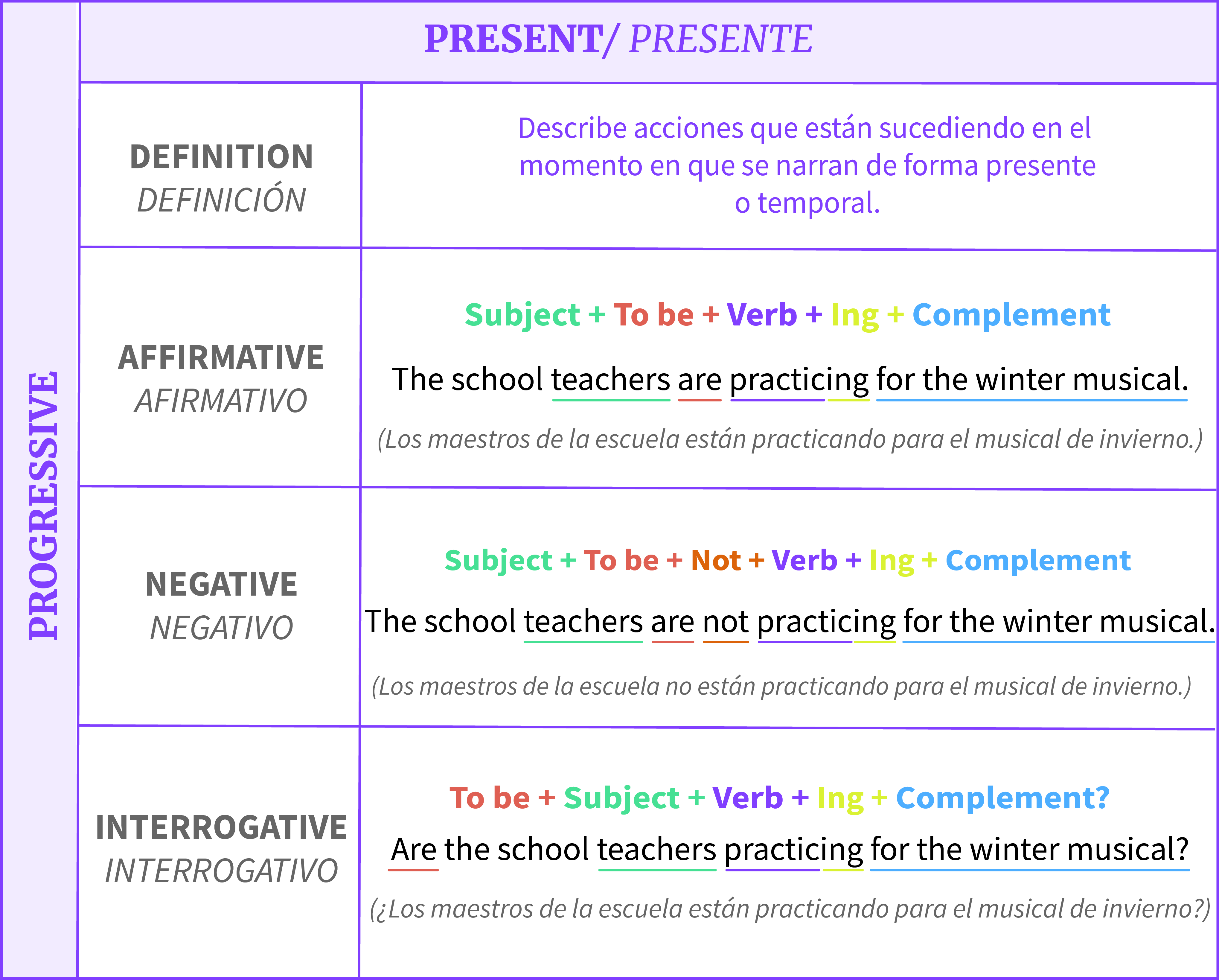
Para complementar mira el video:
Presente continuo en inglés.
https://www.youtube.com/watch?v=a2rCItncHeM
Practice exercise.
Práctica en linea siguiendo los enlaces:
https://www.englishclub.com/grammar/verb-tenses_present-continuous_quiz.htm
https://elt.oup.com/student/solutions/elementary/grammar/grammar_04_012e?cc=ar&selLanguage=en
Taller: Present continuous.
- Jim ________ eating ice cream.
- The kids ________ playing in the park.
- Birds ________ singing on a tree.
- Henry and I ________ watching the final of soccer championship.
- Bees ________ gathering honey in the beehive.
- Tom and Karen ________ skiing on the cold water.
- You ________ washing your hands with a lot of soap.
- Tim ________ crying aolne in the debroom.
- They ________ rowing the boat in the river.
- I ________ drinking wine in a birthday party.
B) Traduce a inglés estas oraciones de presente progresivo. Pasarlas a negativo y a interrogativo.
Ej. 0. Ella esta comiendo albondigas en el restaurante.
Aff. She is eating meatballs in the restaurant.
Neg. She is not eating meatingballs in the restaurant.
Int. Is she eating meatballs in the resturant?
(+) Yes, she is.
(-) No, she is not.
- Yo estoy escribiendo un mensaje.
- Tú estás cantando una canción.
- Andrés está haciendo las tareas.
- Nosotros estamos estudiando español.
- Ellos están conduciendo por la ciudad.
C) Presenta el examen siguiendo el enlace, solo si ya te sientes preparado.
Debe tener una cuenta o correo en GOOGLE para presentar las evaluaciones (Ejemplo: pepito20@gmail.com).
ES NECESARIO ENVIAR PRIMERO EL TALLER Y SABER LA FECHA DE ENVIO.
Evaluación Presente continuo:
https://forms.gle/cihP7bb5Tomkw7Xp8

No hay comentarios:
Publicar un comentario