INGLÉS NOVENO
PLAZO: NOVIEMBRE 13 o Antes mejor
Recomendaciones:
1. Estudiar el contenido y resumir en el cuaderno junto con ejercicios de complementación del tema.
2. Desarrollar cada taller del contenido del blog en el cuaderno.
Tema: Cognados, ICFES
Competencia: Reconoce vocabulario especial en textos y ejercicios para la interpretación de inglés a español. .
_______________________________________________________________
Los cognados son palabras que se parecen en inglés y en español, hay dos tipos:
*True cognates: Palabras idénticas o similares entre español e inglés y significan lo mismo. Ejemplo:
Ejercicio 1: Mira los ejemplos y busca otros 10 ejemplos
Gasoline = Gasolina
Hospital = Hospital
Car = Carro
Stadium = Estadio
Science = Ciencia

*False cognates: Palabras que se parecen en inglés y español pero difieren de significado, y confunden.
Ejemplo
-EXIT: parece a EXITO pero significa SALIDA y éxito es SUCCESS
-ORE parece a ORO pero significa MINERAL y oro es GOLD
Ejercicio 2: Busca y realiza 30 ejemplos con ayuda del diccionario.
Ejercicio 3: copia las oraciones, luego identifica y subraya los cognados falsos, traduce a español:
Example:Did you pay the money for the graduation dinner with a credit card?
Usted pagó el dinero para la cena de graduación con una tarjeta de crédito?
1.The sand of the beach will be the arena for the battle.
2.In this wide meadow is the field that we use for camp.
3.The idioms are common in every language.
4.The spiderman costume is becoming a habit for Halloween.
5.The success in a danger situation in to found an exit quickly.
6.Every new book will be bought in the new bookstore and put in the library.
7.My uncle is brave but my aunt is very fierce when she is upset.
8.The orchestra conductor is working as a driver in a city taxi.
9.The big curse is affecting the last course of the institution.
10. The cellar is in front of the watchman dressing with red cap.
TALLER: NO ENVIAR NADA, el desarrollo del taller se evidenciará en el examen. Este es el examen.
I.Traduce y responde el siguiente test tipo ICFES.
Hystory: Boston
Jean and her family recently traveled to Boston, Massachusetts, one of America’s oldest colonial cities. Boston is rich in history and local personality. During their visit, Jean and her family appreciated learning about Boston’s role during the American Revolution.
In the city, Jean and her family followed the famous Freedom Trail. This is a 2.5-mile route that tourists can explore in order to visit 16 different historical landmarks located throughout the city. Famous sites on this trail include the Paul Revere House, King’s Chapel, and the Bunker Hill Memorial. Jean and her family received a map to navigate the Freedom Trail. The roads were clearly marked by red lines, and there were signs throughout the city to keep Jean’s family and other tourists from getting lost.
As part of the Freedom Trail, Jean and her family spent a lot of time in Boston’s North End. This is one of the oldest residential neighborhoods in the entire country. Here, Jean and her family were able to visit Boston Harbor, which is the site of the historical Boston Tea Party. This event sent a strong message to the British leading up to the American Revolution.
The end of the Freedom Trail led Jean and her Family to the Boston Common, the oldest urban park in the nation. The park is filled with plenty of lush greenery, but it also serves as a burial ground for heroes of the American Revolution.
Because of their walk along the historical Freedom Trail, Jean and her family left Boston with a thorough understanding of early American history.
1) What period of American history did Jean and her family learn about in Boston?
A. The Great Depression. B.The American Revolution. C. The Civil War. D.The Prohibition Era
2) What route did Jean and her family follow to visit 16 historical sites?
A The Boston Common B The North End C Paul Revere Road D The Freedom Trail
3) All of the following prevented Jean and her family from getting lost except:
A Following a knowledgeable tour guide B The clear city signs
C The red markings on the road D Having access to a map
4) What important historical event took place in Boston Harbor?
A The Haymarket Riots B The Boston Tea Party C The Boston Common D The Revolutionary War
5) The Boston Common contains a burial ground for:
A Colonial Boston’s elite families B Heroes of the American Revolution
C Native Americans D Fallen British soldiers
II. Acorde al desempeño personal de todo el taller la nota de mi auto-evaluación es: 3,5 4,0 4,5 5,0
III. Presenta la evaluación. Debes iniciar primero sesión en GOOGLE y
luego dar click al enlace para acceder a la evaluación. NO aparecerá ni una
palabra en el examen, debes poner solo la letra que seleccionaste en cada
número. EJ. 1.A 2.C
3.A… etc. Debe tener correo en GOOGLE (Ejemplo: pepito20@gmail.com).
Evaluación Cognates, ICFES: https://forms.gle/iN9aMLUURep63H2C9
PLAZO: Septiembre 24 o Antes mejor
Recomendaciones:
1. Estudiar el contenido y resumir en el cuaderno junto con ejercicios de complementación del tema.
2. Desarrollar cada taller del contenido del blog en el cuaderno.
Tema:
Modals, ICFES
Competencia: Expresa información contextual como intermediario
para socializar puntos vista y promover la inclusión en aspecto comunicativo en
otro idioma.
_______________________________________________________________
Los verbos modales en ingles se usan como formalidades y ademas conllevan cierto grado de obligacion en el uso de cada uno, dependiendo de la situacion:
-SIEMPRE se usa un verbo en infinitivo despues del modal.

Suggestions
We use should and shouldn't to make suggestions and give advice:
You should send an email. You shouldn’t go by train.
We also use could to make positive suggestions:
We could meet at the weekend. You could eat out tonight.
Abilities and skills
We use can and can't to talk about someone's skill or general abilities:
She can speak several languages. He can swim like a fish. They can't dance very well.
We use can and can't to talk about the ability to do something at a specific time in the present or future:
I can see you. Help! I can't breathe.
We use could and couldn't to talk about the past:
She could speak several languages. I couldn't see you.
Exercise on modals use:
A. Answer the questions, then complete and translate to Spanish.
Question1. I didn’t feel very well yesterday. I ..... eat anything.
a. cannot b. couldn’t c. mustn’t
Question 2. You ..... look at me when I am talking to you.
a. could b. should c.would
Question 3. I was using my pencil a minute ago. It ..... be here somewhere!
a. can b. could c. must d. would
Question 4. You really ..... be late again to the dentist appointment.
a. must not b. don’t have to be c.may not
Question 5 I didn’t feel very well yesterday. I ..... eat anything.
a.cannot b.couldn’t c.mustn’t
Question 6 You ..... look at me when I am talking to you.
a.could b.should c.would
Question 7 I was using my pencil a minute ago. It ..... be here somewhere!
a.can b.could c.must d.would
Question 8 You really ..... be late again to your work interview.
a.must not b.don’t have to be c. cannot
Question 9 If you don’t start working harder, you ..... repeat the course next year.
a.have to b.must c.will have to
Question 10 You ..... forget your sun cream. It’s going to be very hot!
a.don’t have to b.mustn’t c.needn’t
B. According to the picture content, write a sentence using the modal verbs.
Example Picture 1:
You must use special clothes in this area.

C. Practice online:
https://reviewgamezone.com/mc/candidate/test/?test_id=15399&title=Modal%20Verbs
TALLER:
NO ENVIAR NADA, el desarrollo del taller se evidenciará en el examen. Este es el examen.
I. Traduce y responde el siguiente test tipo ICFES.
Yellowstone National Park

Yellowstone National Park, located in Idaho, Montana, and Wyoming, was established as the first national park in the United States. The park is a popular destination for visitors who enjoy ecological tourism as it offers forests, mountains, and abundant ecosystems to explore. Some of Yellowstone's most well-known landmarks are its geothermal hot springs and geysers, the most famous of which is named Old Faithful.
Last fall, Lisa and her friends decided to take a camping trip to Yellowstone National Park. They arranged to stay at one of the park's many convenient campsites. For their camping trip, they brought their backpacks, sleeping bags, and a cooler of food and drinks. They pitched their tents immediately upon arriving to their campsite. During their trip, Lisa and her friends hiked the many trails of the park, exploring its natural surroundings. In the forest, they saw a lot of local wildlife. Lisa was surprised to see a family of grizzly bears, some gray wolves, and even bald eagles flying overhead.
Outside of the woods, they admired the beauty of some of Yellowstone's natural cascades. Since Yellowstone contains many hot springs and the world's largest area of active geysers, Lisa and her friends visited many different geyser sites. They even spent an afternoon swimming in Yellowstone's Boiling River. Of all of the sites, Lisa and her friends agreed that Old Faithful was the most impressive. Lisa and her friends waited patiently for the geyser to erupt. After about 40 minutes, a stream of boiling water over 100 feet tall sprayed from the ground and up into the air. Fortunately, no one got wet!
1) Yellowstone is an important national park in the United States because:
a. It is the country's first national park. b. It is the largest U.S. national park.
c. It is the most ecologically diversenatural park. d. It is the most visited U.S. national park
2) When did Lisa and her friends visit Yellowstone National Park?
a. Last spring b. Last summer c. Last autumn d. Last winter
3) Where did Lisa and her friends stay during their visit to the park?
a. In a log cabin b. In a rental home c. At a hotel d. At a campground
4) All of the following are animals that Lisa saw during her trip except:
a. Grizzly bears b. Wild horses c. Gray wolves d.Bald eagles
5) Why did Lisa and her friends wait patiently when visiting Old Faithful?
a. They arrived an hour before the geyser opened to the public.
b. They were still wet from swimming in the Boiling River.
c. There was a long line to see the geyser.
d. The geyser took about 40 minutes to erupt.
II. Acorde al desempeño personal de todo el taller la nota de mi auto-evaluación es: 3,5 4,0 4,5 5,0
III. Presenta la evaluación. Debes iniciar primero sesión en GOOGLE y
luego dar click al enlace para acceder a la evaluación. NO aparecerá ni una
palabra en el examen, debes poner solo la letra que seleccionaste en cada
número. EJ. 1.A 2.C
3.A… etc. Debe tener correo en GOOGLE para presentar las evaluaciones
(Ejemplo: pepito20@gmail.com).
Evaluación Modals, ICFES: https://forms.gle/BJaHUQL6VGFMHXsw9
PLAZO: JULIO 21 o Antes mejor
Recomendaciones:
1. Estudiar el contenido y resumir en el cuaderno junto con ejercicios de complementación del tema.
2. Desarrollar cada taller del contenido del blog en el cuaderno.
Tema:
Huilensidad - Myths.
Competencia: Interpreta textos descriptivos
con coherencia y cohesión sobre la cultura regional usando aspectos
descriptivos.
___________________________________________________________________

The Man in the Hat
The legend of the Sombrerón supposedly began with a real villager. He dressed all in black and rode a black horse and was a stern-faced, well-dressed man who harmed no-one. But when he died his spirit became the terror of those who wander the streets at night and cause mischief (drunks, cheats, gamblers and fighters) The Sombrerón is said to chase his victims through lonely, moonlit areas where he is sometimes accompanied by two fearsome black dogs. This legend is told most often in Antioquia, although the “Black Rider” and “Headless Horseman” often described in Tolima, Huila and the Cauca Valley share many of his characteristics.
The Mohán
The mohán is everyone’s favourite monster. Although his description does vary from place to place, he is usually a huge creature, covered in hair with long, claw-like nails. He sometimes has red eyes and gold teeth and is fond of mischief. Fisherman say the mohán capsizes boats and steals bait and hooks. Washerwomen claim he bewitches girls with music and tricks. He is also said to guard ancient treasures in his underground palace and his appearance heralds the arrival of floods, earthquakes and plagues. The mohán is sometimes known as “Poira” and his story is most commonly told in Tolima.
The wailer
The llorona is a wandering woman who carries a child through the streets. She’s muddy, wild-eyed and dressed in rags and never shows her face. Some legends say she screams for aid, but anyone who carries the infant inherits the curse to become the new llorona. The spirit is said to stalk lonely places and appear to anyone plotting mischief. Some say she was a jealous woman who killed the child’s mother in rage. Others that she was a desperate wife who killed herself, and a child she had with her lover, when she heard her errant husband was returning from war. The story of the wailing woman is particularly popular in eastern Colombia.
The One-Legged Woman
The patasola lives in dense jungle and is especially feared by miners, hunters, farmers, hikers and loggers – not least for the pace with which she moves through the jungle on just one leg. Some say the patasola appears as a beauty who entices men into her lair then traps them as an ugly, wild-eyed woman. Others say she attracts men by screaming for help before transforming into a murderous, blood-sucking beast. Men supposedly tell the story of the patasola to frighten their wives into being faithful and also instill a wariness of the jungle. It is thought the story originated in Tolima.
TALLER:
De forma
creativa a mano, con la información del contenido, realiza un poster, afiche o
cartel descriptivo de un mito en inglés, con una leyenda o escrito de mínimo 8
renglones. Puedes usar una hoja de block. Tomar fotografía legible y enviar
wasap con nombre y curso. Ejemplo:

PLAZO: JUNIO 16 o Antes mejor
Recomendaciones:
1. Estudiar el contenido y resumir en el cuaderno junto con ejercicios de complementación del tema.
2. Desarrollar cada taller del contenido del blog en el cuaderno.
Tema:
Testing ICFES Proof.
Competencia: Desarrolla
habilidades de competencia para desarrollo de pruebas SABER.
___________________________________________________________________
Teniendo en cuenta el conocimiento y habilidades adquiridas en cuanto a contenidos y competencias comunicativas en el idioma inglés, desarrolla el siguiente material preparativo tipo ICFES-SABER.
Ejercicio Práctico.
Lee interpretando comprensivamente los ejercicios, traduce y responde.
1) Traduce y relaciona con colores las oraciones con la palabra del vocabulario de la derecha.

2) Traduce y completa las conversaciones.

TALLER:
NO ENVIAR NADA, el desarrollo del taller se evidenciará en el examen.
A) Lee interpretando comprensivamente los ejercicios, traduce y responde. Esta es la evaluación.

B)
Presenta la evaluación del tema siguiendo el enlace. Debes iniciar primero
sesión en GOOGLE y luego dar click al enlace para acceder a la evaluación.
Debe tener una cuenta o correo en GOOGLE para
presentar las evaluaciones (Ejemplo: pepito20@gmail.com).
Evaluación ICFES proof.
https://forms.gle/Rnd7tpoUuVhZUNbn7
¿No tienes internet? DESCARGA EL MATERIAL EN PDF:
Tema: Simple Past Repast and linking words
Competencia: Cuestiona y argumenta situaciones personales y de su entorno a través de explicaciones sencillas, razonables y coherentes.
___________________________________________________________________
Primero hay que saber que hay dos clases de verbos. Regular e Irregulares, los irregulares se encuentran comúnmente en un listado con sus formas de pasado en frente, y los verbos regulares obtienen su forma de pasado con la terminación en _ED. pero siguiendo ciertas reglas.
VERBS
REGULAR Verbs IRREGULAR Verbs
*terminan en ED *tienen listado *No siguen reglas *Hay que memorizarlos
Regular verbs Rules Example
R1: verbo termina en _e agrega d Dance - danced
R2: Verbo termina en _s,sh, ch, x, z agrega _ed Watch -Watched
R3: Verbo termina en _letra + Y remplaza Y por _ied Copy - copied
Si verbo no cumple ninguna regla agrega _ed Talk - talked
Auxiliar del tiempo pasado simple:
El verbo Do en pasado (DID) funciona como auxiliar en oraciones negativas e interrogativas, importante recordar que si va el auxiliar en una oración, el verbo principal de la oracion debe ir normal.
OJO: oraciones con ser o estar (BE) siempre se usa este mismo verbo.
Pronouns Do BE
I Did was
YOU Did were
He - She - It Did was
We Did were
They Did were
Lucy trabajó duro ayer. Yo estaba en el parque ayer.
Affirmative Lucy worked hard yesterday. I was in the park yesterday.
Negative. Lucy did not work hard yesterday I was not in the park yesterday
Interrogative. Did Lucy work hard yesterday? Was I in the park yesterday?
OJO: para saber cómo clasificar un verbo, PRIMERO debemos buscarlo en el listado de irregulares, si aparece, es irregular por tanto tiene su forma de pasado en frente, si no aparece, suponemos que es regular y aplicamos regla correspondiente.
Tipos de Oraciones
Affirmativas: Deben llevar el verbo en pasado, y pueden ir complementadas con expresiones de tiempo.
Negativas: Se usa la particula carcteristica de negacion "NOT" despues del auxiliar del pasado.
Interrogativas: Se inician con una clausula WH- si requiere información como respuesta o primero el auxiliar para respuestas simples: si, no.
Practice exercises:
1. Write the meaning and the past of next verbs, Circle color red the irregular verbs and color blue the regular verbs.
Paint Go Think
Buy Drink Eat Mix
Shout Scream Arrive
2. Complete the next sentences in past and translate to Spanish.
a. My father (buy) _____________ a new TV yesterday in the market.
b. The Mayor (shout)______________ to the people “I promise that”.
c. The study (show)_________ that lot of people (eat) ________ junk food for dinner.
3. Complete, write the sentences in Affirmative, negative or interrogative.
Example. Aff. The red Bull (run)_ran_ fast in the meadow.
Neg. The red bull did not run fast in the meadow
Int. Did the red bull run fast in the meadow?
+Yes, It did.
- No, It did not.
a. Aff.
Neg. The lions did not hunt the zebra yesterday.
Int.
+
-
b. Aff.
Neg.
Int. Did she come to my house last night?
+
-
MY VACATIONS
On my last vacation my family and I went to California. Every day in the morning we ate corn flakes and my father ate bacon with eggs and drank orange juice. My sister washed the dishes, my grandmother swept the floor and cleaned the bedrooms, and I swam in the pool. In the afternoon we rode bikes and went to the beach. At night I watched tv. And my brother jumped rope and played soccer. My mother and father read magazines.
Example. Where did I go vacations? On my last vacation my family and I went to California.
a. What did we usually eat for breakfast? _________________________
b. What did we usually do in the afternoon? ______________________
c. What did usually do my parents at night? ______________________
LINKING WORDS AND CONNECTORS
Son palabras que sirven de enlace para dar coherencia a las ideas y seguir un desarrollo de las mismas.
Entre estos linking words tenemos:

El uso se evidencia por ejemplo de la siguiente manera, tenemos unas oraciones, que podemos unir y formar un texto coherente con los linkings adecuados:
Sentences:
Michael suffered a normal car accident last weekend.
The newspaper described a car accident in the main page.
The doctor said the man was out of danger.
Linking word use:
Michael suffered a normal car accident last weekend. therefore the newspaper described a terrible car accident in the main page, however the doctor said the man was out of danger.
Practice:
1. Use a linking word to join the sentences:
a. He promised me that you will phone me ________________ you arrived to the airport.
b. Jen said to look after animals ____________ she was alone on holiday.
c. He felt tired _________________ he watched the soccer match.
Taller:
NO ENVIAR NADA, el desarrollo del taller se evidenciará en el examen.
A) Recuerda hechos históricos de los libertadores o de ese tiempo, debajo cada imagen describe usando al menos un verbo regular y uno irregular en pasado sobre esos hechos.

B). A modo de cuento, organiza las oraciones del punto anterior, reecribe todo en un solo texto, como si fuera una historia, usando conectores while / meanwhile / moreover / furthermore / sudenly. Escribe los conectores con color diferente y subraya los verbos en pasado. Trata de dar coherencia al cuento.
C) Presenta la evaluación de pasado simple siguiendo el enlace. Debe primero iniciar sesion en GOOGLE para poder ingresar a la evaluación.
Debe tener una cuenta o correo en GOOGLE para presentar las
evaluaciones (Ejemplo: pepito20@gmail.com).
Evaluacion Pasado simple and Linking words
https://forms.gle/VBc7rLacAX2mLFmR9
¿No tienes internet? DESCARGA EL MATERIAL EN PDF:
https://drive.google.com/file/d/1k5uFOW3uAGNlmiiup33OalB5MLSuI-Yb/view?usp=sharing
OBSERVACIONES DE TRABAJO ACADÉMICO.

Escribir nombre grado y codigo en el mensaje.
Recomendación:
Tema: Present continuos
Competencia: Comprende la composición gramatical del tiempo presente continuo y pasado continuo para expresar e interpretar textos en un contexto comunicativo.
___________________________________________________________________
El gerundio o -ING
1. Si el verbo acaba en -e, hay que reemplazarla por -ing. Excepto: See → Seeing be→ being
Ej. eat → eating ask → asking go → going
Para compementar mira el video:
Uso y reglas del ing con ejemplos.
https://www.youtube.com/watch?v=PeubuXzxS-0
Practice exercise.
Aplica las reglas de gerundio a los siguientes verbos para convertilos a forma continua.
Ej. 0. Complete - completar - completing - completando
1. Start
2. Copy
3. Win
4. Stop
5. Play
6. Understant
7. Forget
8. Do
9. work
10. Bit
B) Completa las siguiente oraciones agregando el gerundio (-ing) a los verbos en parentesis, luego traduce las oraciones.
(tomado de: https://www.superprof.es.)
Present continuous or present progressive
Se usa para expresar hechos del presente que se estan llevando a cabo.
Se llama presente continuo porque debe ir:
Presente continuo
verbo "To Be Verbo de la
conjugado oracion en -ing
en presente
Ej. Camilo is playing in the park
Camilo está jugando en el parque.
Ej: Los estudiantes están corriendo a lo largo de la playa.
the students are running along the beach.
Recordamos que el verbo "Be" significa ser/estar y se conjuga de acuerdo a las personas o pronombres de la siguiente forma en presente:
Pronouns Be
Forma de oraciones en presente continuo o progresivo:
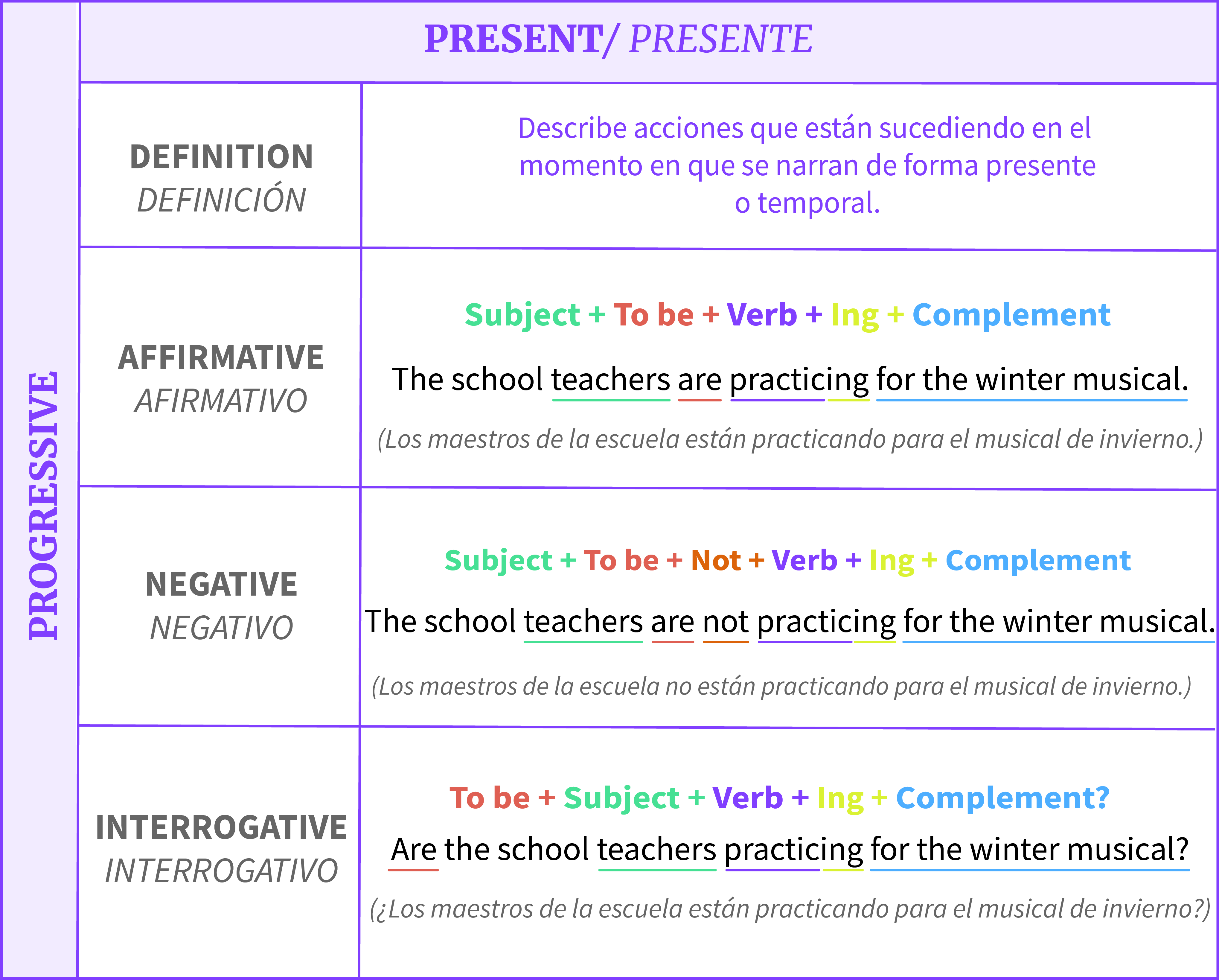
Para complementar mira el video:
Presente continuo en inglés.
https://www.youtube.com/watch?v=a2rCItncHeM
Practice exercise.
Completa las oraciones de presente continuo solo con el verbo To Be. Traducelas a español.
- Jim ________ eating ice cream.
- The kids ________ playing in the park.
- Birds ________ singing on a tree.
- Henry and I ________ watching the final of soccer championship.
- Bees ________ gathering honey in the beehive.
Taller: Present continuous:
A) Completa las oraciones en presente continuo. Traducelas a español.
- Tom and Karen ________ (swim) in the cold water.
- You ________ (wash) your hands with a lot of soap.
- Tim ________ (cry) aolne in the debroom.
- They ________ (pull) the boat to the river.
- I ________ (drink) wine in a birthday party.
B) Elige, encierra en circulo y completa con la opción correcta para llenar las oraciones en presente continuo.
C) Presenta la evaluación de presente continuo siguiendo el enlace.
Debe tener una cuenta o correo en GOOGLE para presentar las evaluaciones (Ejemplo: pepito20@gmail.com).
Evaluacion Presente continuo
https://forms.gle/QL2YRCT29KNNWokM7
Tema: Past continuous
MAYO 4 a 14 - SEGUNDO PERIODO
El pasado continuo tiene la misma referencia del presente continuo, solo que la diferencia va en el verbo To Be, que ahora debe ir en pasado así:
Se usa para expresar hechos del pasado que se estaban llevando a cabo, diferente al presente continuo ahora el verbo BE va en pasado.
Se llama pasado continuo porque debe ir:
Pasado continuo
verbo "To Be Verbo de la
conjugado oracion en -ing
en pasado
Ej. Camilo was playing in the park
Camilo estaba jugando en el parque.
Ej: Los estudiantes estaban corriendo a lo largo de la playa.
the students were running along the beach.
Ahora recordamos que el verbo "Be" significa ser/estar y se conjuga de acuerdo a las personas o pronombres de la siguiente forma en pasado:
Pronouns Be
I Was yo estaba / era
You Were usted estaba / era
He - She - It Was el-ella-eso estaba / era
We Were nosotros estabamos / eramos
They Were ellos/ellas estaban / eran
Tipo de oraciones en pasado continuo:
Affirmative sentences:
Negative sentences: was not = wasn’t were not = weren’t
Interogative sentences:
Practice exercie past continuous.
Selecciona el verbo Be en pasado was o were acorde al caso y completa el verbo en -ing.
- I was / were play____ (Yo estaba jugando)
- You was / were sleep___ (Tú estabas durmiendo)
- He was / were eat_____ (Él estaba comiendo)
- She was / were jump_____ (Ella estaba saltando)
- It wasn't /weren't cry____ (eso no estaba llorando)
- We was /were sleep____ (Nosotros/as estábamos durmiendo)
- You wasn't / weren't play____ (usted no estaba jugando)
- They was / were speak____ (Ellos/as estaban hablando)
Taller: Past continuous.
A) Completa el siguiente texto en pasado continuo. Luego traducelo a español. Representalo graficamente.
Tom (save) ………………… money for months to go to France
and yesterday he realized that he had enough cash, but when
he (drive) ………………. to the travel agency he (remember) ………………
that he did not pay the rent, very dissapointed, he (turn) ……………… back
and he (arrive) ……………… home. He (get) ……………… very ungry when
B) Vocabulary.
Utiliza los siguientes hobbies para realizar en cada caso una oracion en pasado continuo.
C) Presenta la evaluación de pasado continuo siguiendo el enlace.
Debe tener una cuenta o correo en GOOGLE para presentar las evaluaciones (Ejemplo: pepito20@gmail.com).
ES NECESARIO ENVIAR PRIMERO EL TALLER Y SABER LA FECHA DE ENVIO.
Evaluación: pasado continuo.
https://forms.gle/RAutw7aug2XnaNht5

No hay comentarios:
Publicar un comentario